
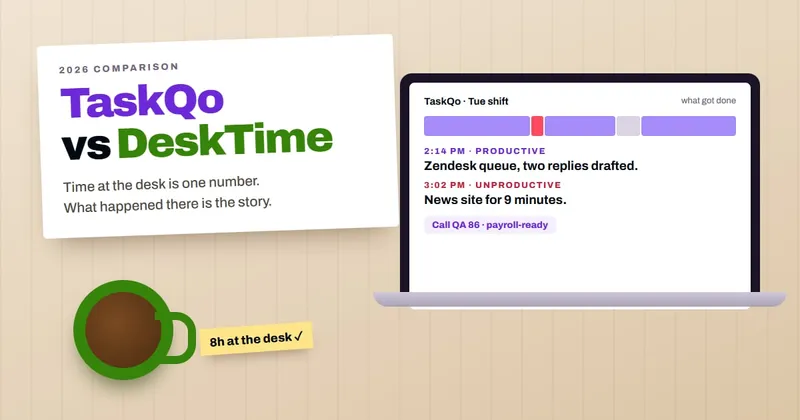
Who wrote this: the TaskQo team. We make TaskQo, so read this as our view. We checked DeskTime's public website on October 12, 2026 and link every source at the end. Products change quickly: if something here is out of date, email admin@taskqo.com and we will fix it.
Quick verdict
For a small team that only needs simple automatic time tracking, DeskTime is a good, honest tool. For agent teams where you need to explain performance to clients and coach calls, TaskQo does far more.
Choose TaskQo if
- You need every minute explained with a screenshot, not just app totals
- You want call transcripts, QA scores and coaching notes
- You need payroll-ready hours with overtime, breaks and approvals
Choose DeskTime if
- You like "Private Time", which lets people pause tracking themselves
At a glance
| Feature | TaskQo | DeskTime |
|---|---|---|
| Best for | BPOs, call centers, support and sales teams that need to know what got done, not just hours | Small teams to enterprises that want automatic time tracking with a self-view |
| How work is classified | Every tracked minute is labelled productive, unproductive or idle. Clear-cut work is classified from the app in focus; AI vision reviews the rest. Each result shows its screenshot and a one-line reason | Admins sort apps and sites into productive, unproductive or neutral (new apps default to neutral), per account or team |
| Screenshots and video | One screenshot per tracked minute; optional screen video compiled into one replay per shift, with chapters at flagged moments | Premium: screenshots every 5, 10, 15 or 30 minutes at random times, optional blur. No video listed |
| Call recording and QA | Yes. Records both sides of supported calls and meetings during shifts; one-click speaker-labelled transcript in 39 languages, QA score and coaching notes | Not listed |
| Shifts, attendance and pay | Fixed or flexible shifts, leave, holidays, overtime and breaks; hourly and salary pay with deductions; weekly approval; payroll-ready CSV and timesheet PDF | Shift scheduling (Premium), absence calendar, attendance, offline time. Payroll not listed |
| Privacy and self-view | Consent recorded before the first capture; capture only inside shifts; every team member has a self-view with the same timeline as their manager; sensitive screens kept only as a general description | Team members see their own stats as managers see them on My DeskTime; Private Time pauses tracking; own screenshots visible if the admin allows |
| Mouse jigglers and other cheating | Flags patterns linked to mouse jigglers, remote-desktop sessions and virtual machines, with the minutes attached. A person decides; a flag never changes pay or scores | Idle tracking; no mouse-jiggler detection listed |
How each tool decides what counts as productive
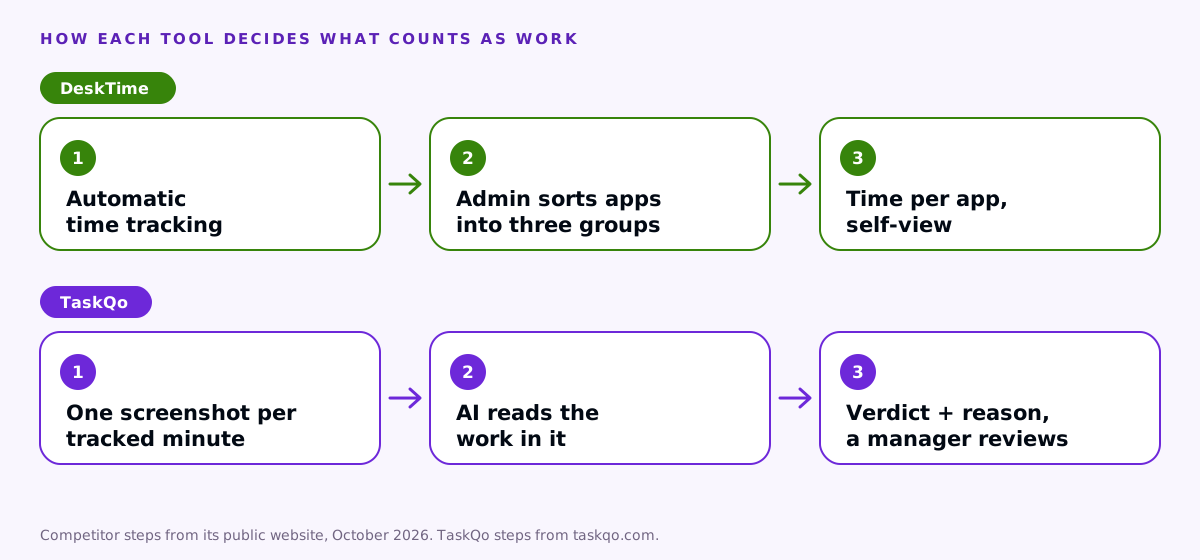
DeskTime tracks apps and websites automatically and lets admins sort them into productive, unproductive or neutral, with new apps defaulting to neutral. It also offers an AI summary of daily activity in text.
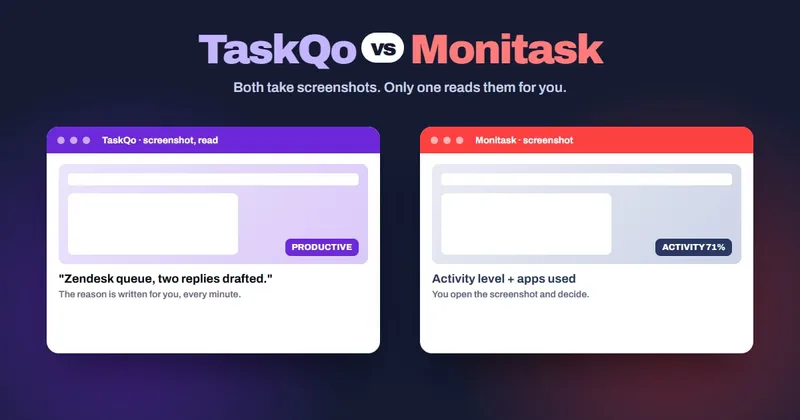
TaskQo classifies every tracked minute rather than every app, and shows the screenshot and a one-line reason for each. That matters when the same browser can hold a customer ticket or a news site.
Screenshots
On DeskTime's Premium plan, screenshots can be taken every 5, 10, 15 or 30 minutes at random times, with optional blur.
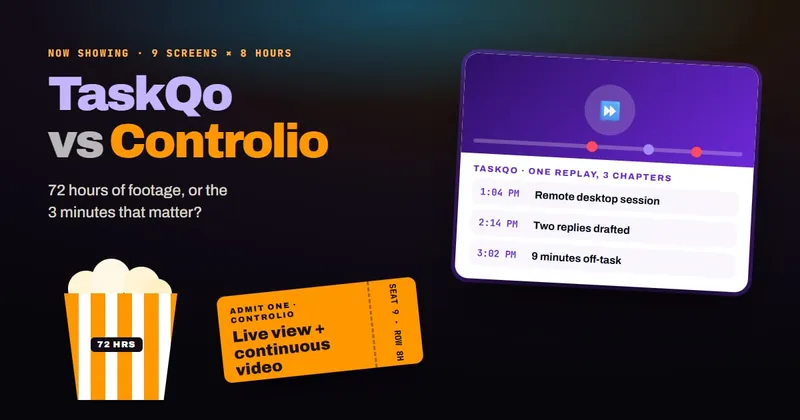
TaskQo takes one screenshot per tracked minute, because each classification is built on it, and can compile an optional screen video into one replay per shift with chapters at flagged moments.
Call review and coaching
DeskTime does not list call recording or QA.
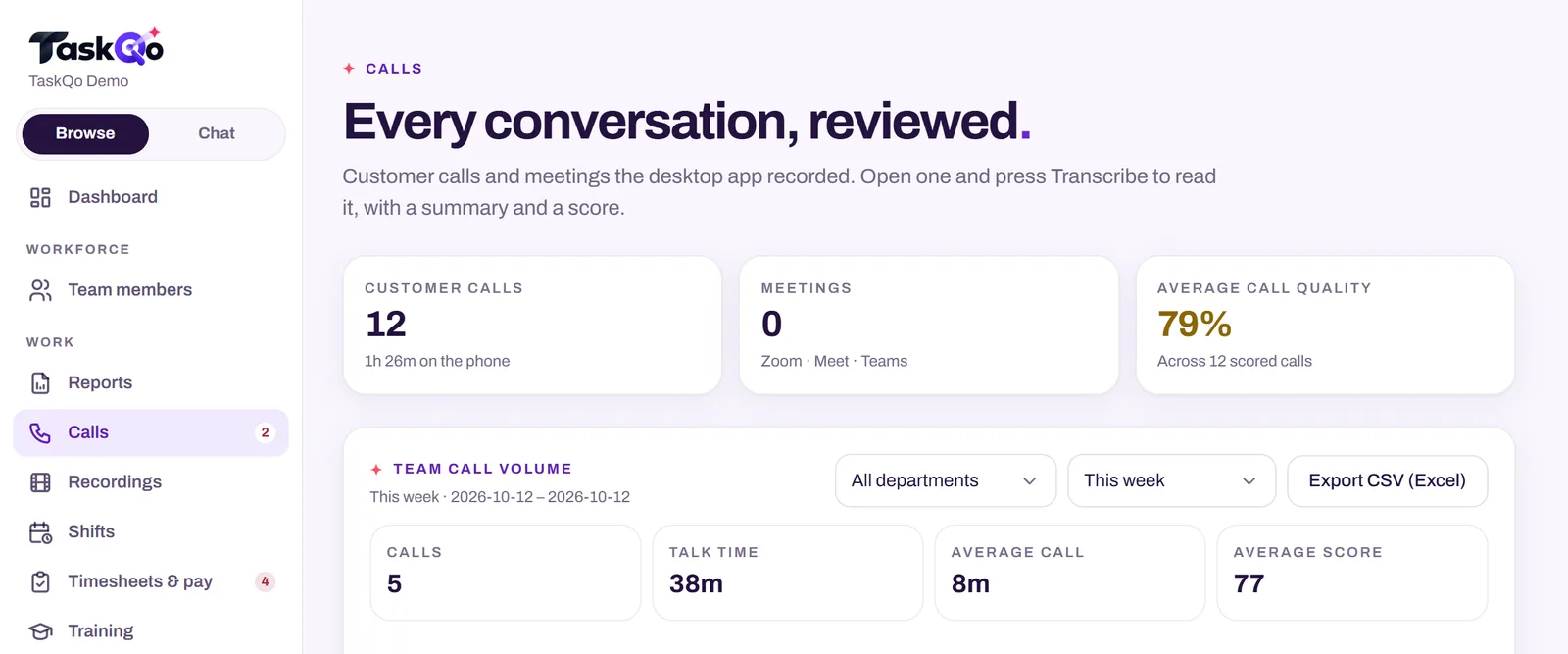
When call review is on, TaskQo records both sides of supported calls and meetings during configured shifts. One click on a recording gives a speaker-labelled transcript in 39 languages, a QA score for communication, issue resolution and professionalism, the customer's reaction, and coaching notes a manager can act on.
Transparency: something both get right
DeskTime's My DeskTime page shows team members their own stats exactly as managers see them, and Private Time lets people pause tracking.
TaskQo makes the same promise, with the reason behind each classification on the team member's own timeline. It also records consent before the first capture and stops capture automatically outside scheduled shifts.
Shifts, attendance and pay
DeskTime offers shift scheduling on Premium, an absence calendar, attendance and offline time, but no payroll.
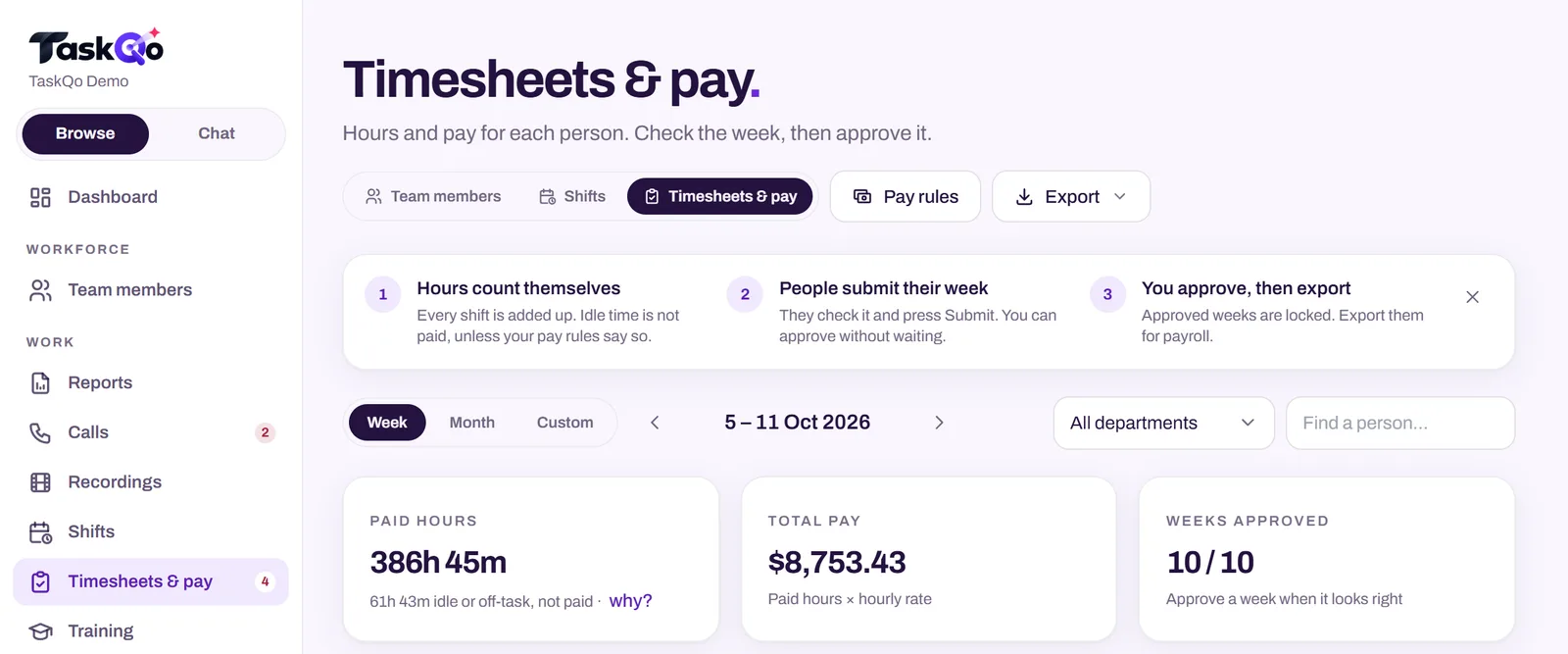
TaskQo calculates attendance, overtime, breaks and holiday pay from tracked work and exports payroll-ready CSV and timesheet PDFs after a weekly approval.
Pricing
DeskTime publishes Pro at $6.42 and Premium at $9.17 per user per month billed annually, or $7 and $10 monthly (excluding VAT), with a 14-day trial.
Where DeskTime is stronger
- Private Time for people who want to pause tracking themselves
Switching from DeskTime to TaskQo
Start with one team rather than the whole company. Install the TaskQo desktop app, set the shift schedule and monitoring settings, invite the team, and compare the first few shifts with what your current tool told you. Performance data builds from the first tracked shift.
Related guides: Idle time tracking: how to read idle time fairly · Shift adherence: tracking late starts and breaks fairly.
FAQ
Is TaskQo a good DeskTime alternative?
It is if you need every minute explained with a screenshot, not just app totals. If you want people to pause tracking themselves with Private Time, DeskTime may still suit you better.
Can team members see their own data in DeskTime?
Yes, on My DeskTime. TaskQo also gives every team member the same timeline their manager sees, with the reason for each classification.
Does DeskTime take screenshots?
On the Premium plan, at 5, 10, 15 or 30-minute intervals.
Does DeskTime calculate payroll?
Payroll is not listed on DeskTime's website. TaskQo exports payroll-ready hours.