
Key takeaways
- Adherence asks whether people were on schedule at the right times; conformance asks whether they worked the total time.
- Late starts and long breaks matter most when they cluster at busy times.
- Agree the rules, the grace periods and the exceptions before you measure.
- Tie attendance to verified work time so payroll and adherence use the same record.
What is shift adherence?
Shift adherence is how closely a person's actual working time matches their schedule. In a call center or BPO, the schedule is built around expected demand, so if agents start late, stretch breaks or log off early, customers wait longer even when headcount looks fine on paper.
Adherence is usually measured as the share of scheduled time a person was actually in the state the schedule expected: working when they should be working, on break when they should be on break.
It is a useful number, but it is easy to misuse. This guide covers what it measures, how it differs from conformance, and how to track it fairly.
How is shift adherence usually tracked?
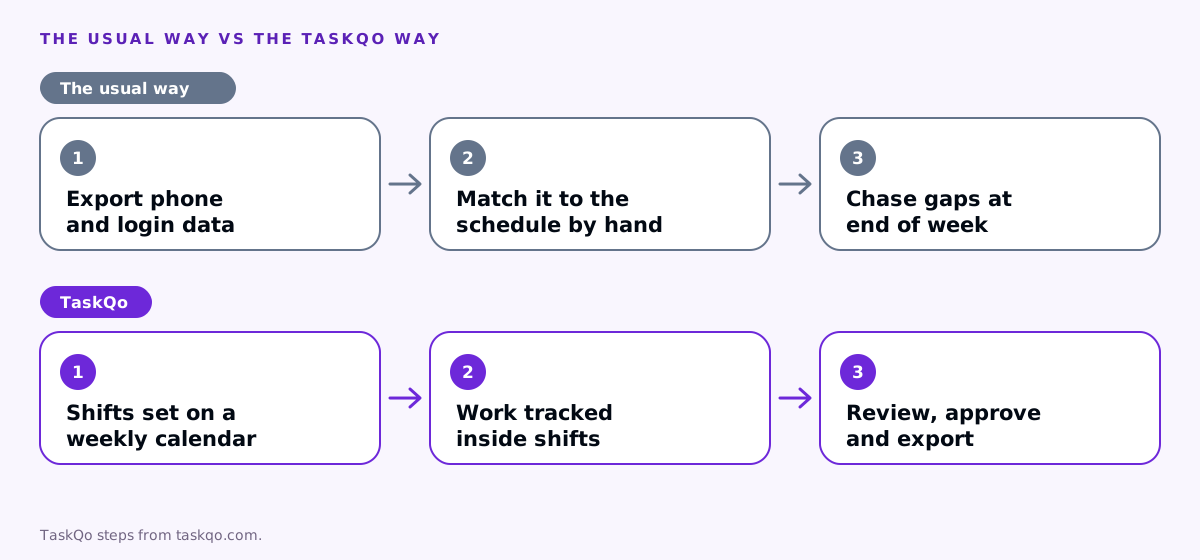
Many teams track adherence with a mix of phone system states, login times and a team lead's notes. Someone exports the data, lines it up against the schedule in a spreadsheet and chases the gaps at the end of the week.
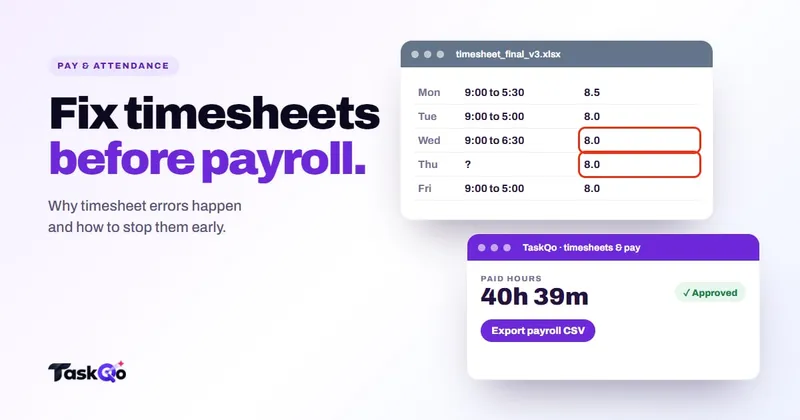
This works, but it has blind spots. Phone states only cover time on the phone system. Login times show when someone opened a laptop, not when they started working. And the spreadsheet usually arrives too late to fix anything in the shift that mattered.
The more useful setup ties the schedule, the tracked work time and the breaks into one record, so adherence, attendance and payroll all read from the same source.
Adherence vs conformance: two different questions
These two terms are often mixed up, and the difference matters.
- Adherence asks: were you working at the times you were scheduled? An agent who starts an hour late and stays an hour late has poor adherence, even though they worked a full shift.
- Conformance asks: did you work the total time you were scheduled? The same agent has good conformance, because the hours add up.
For a phone queue with peaks, adherence usually matters more, because the schedule was built to cover the busy hours. For back office work with flexible deadlines, conformance may be enough. Decide which one fits each team, and do not use one to judge work that was scheduled for the other.
Flexible shifts change the picture again. If a person may start any time in a window, a late start inside that window is not a late start at all.
Late starts, long breaks and early finishes
Most adherence problems come from a handful of moments in the day.
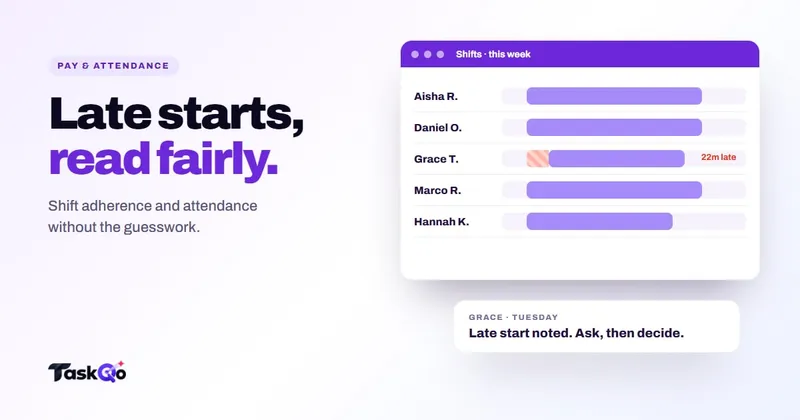
- Late starts. Often caused by slow logins, updates or VPN trouble rather than lateness. Check whether the start-of-shift routine itself takes time.
- Long breaks. A break that runs over by a few minutes every time adds up across a team. A clear allowance and a gentle reminder usually fix it.
- Early finishes. Sometimes a quiet queue, sometimes wrap-up work happening off the system. Ask before assuming.
- Unplanned time off the queue. Team meetings, coaching and system outages should be scheduled or logged as exceptions, not counted against the person.
Look at when these happen, not just how often. Ten minutes late on a quiet morning matters less than ten minutes late at the start of the busiest hour.
Setting rules that people see as fair
Adherence tracking goes wrong when the rules feel arbitrary. Before you start measuring, agree and share a short set of rules:
- A grace period. A small allowance at start and end, so a slow login is not a write-up.
- A break allowance. How long, how many, and whether they are fixed or flexible.
- Exception codes. Meetings, training, coaching, IT outages and approved leave, logged so they do not count as missed time.
- A review step. People can see their own record and ask for a correction.
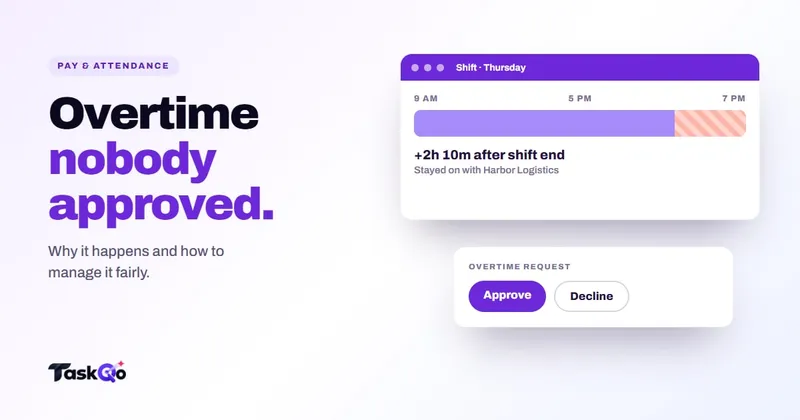
- A clear link to pay. Overtime only with approval, and breaks and leave treated the same way for everyone.
Pay and attendance rules differ by country and state, so check local law or ask counsel about breaks, overtime and deductions. For more on the overtime side, see our guide to unapproved overtime.
Using adherence data without nitpicking
The point of adherence data is to keep the queue covered, not to catch people out. A few habits keep it constructive.
- Look at trends, not single days. One late start is life. A pattern over several weeks is worth a conversation.
- Start with the team, then the person. If everyone is late after lunch, the lunch schedule may be the problem.
- Ask first. Childcare, transport or a slow laptop are common causes and often easy to solve.
- Recognize good adherence. People who reliably cover the busy hours are carrying the queue. Say so.
Clean attendance data also makes payroll easier. Our post on timesheet errors shows how manual timesheets drift away from what really happened.
Shift adherence for remote and hybrid teams
Adherence used to be easy to see on a call center floor: you could look across the room and see who was at their desk. With remote and hybrid teams, managers rely entirely on data, and that raises a few extra questions.
- Logged in is not the same as working. A laptop that is open at 9:00 does not tell you the shift started. Look at whether work actually began, not only at the login time.
- Not every task happens in the phone system. Email queues, chat, ticket follow-ups and client reports are real work. If adherence only counts phone states, people doing back office tasks look off schedule when they are not.
- Time zones and split shifts. Make sure the schedule, the data and the report all use the same time zone, and that split shifts are scheduled as two blocks rather than one long one.
- Home interruptions. A short delivery at the door is not a policy breach. Long, repeated gaps during peak hours are worth a conversation.
The more your adherence data reflects real work across all the tools people use, the fewer disputes you will have. It also helps to tell remote team members exactly what counts as working time, so nobody has to guess whether a quick break to restart a frozen laptop will be held against them.
Finally, keep adherence and productivity separate in your head. A person can be perfectly on schedule and still struggle with the work, or slightly off schedule and excellent at it. Both views matter, but they answer different questions.
How TaskQo tracks shifts and attendance
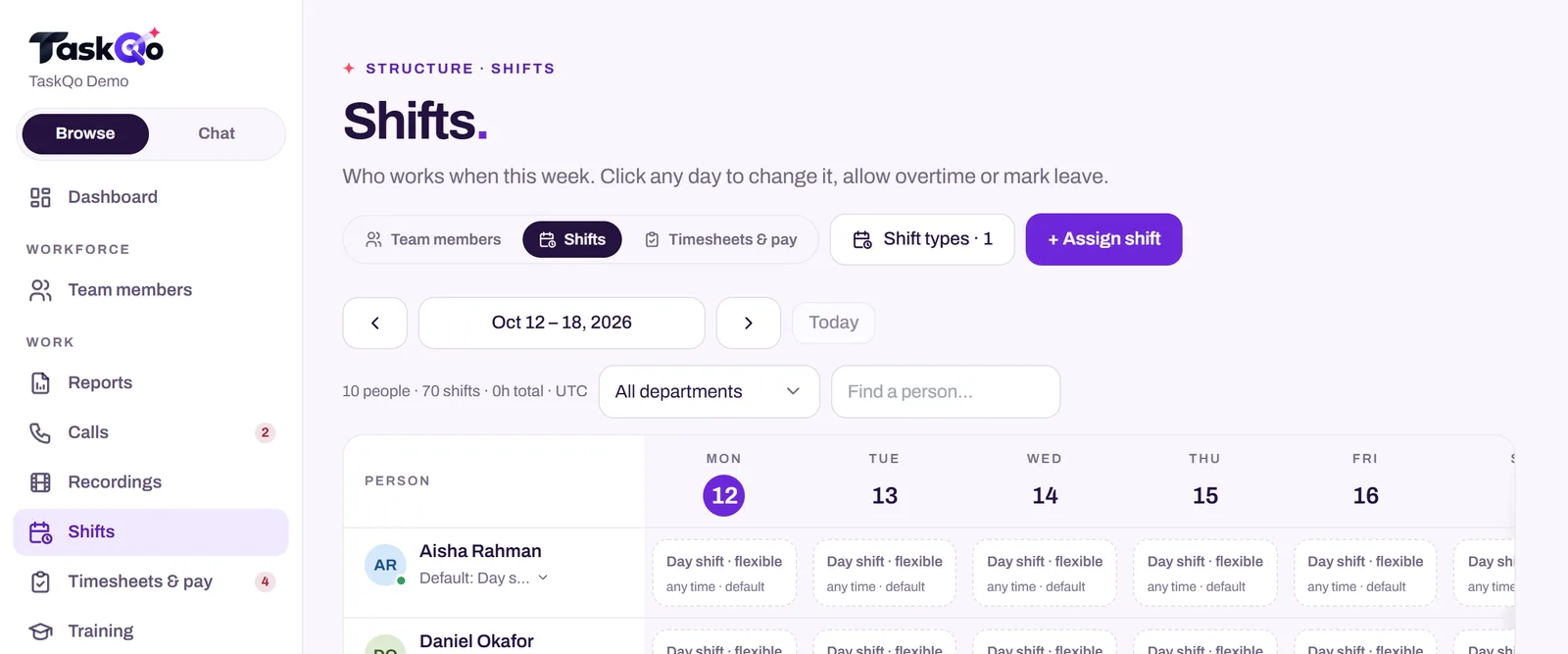
In TaskQo you set fixed or flexible shifts on a weekly calendar with leave and holidays, and monitoring runs only inside them. Capture is switched off outside configured shifts, so attendance is built from scheduled work time rather than from when a laptop happened to be on.
TaskQo calculates attendance, overtime, breaks and holiday pay from tracked work. Managers review and adjust the week, for example adding time when someone stayed on with a client after the tracker closed, then approve it before anything is exported as a payroll-ready CSV or timesheet PDF.
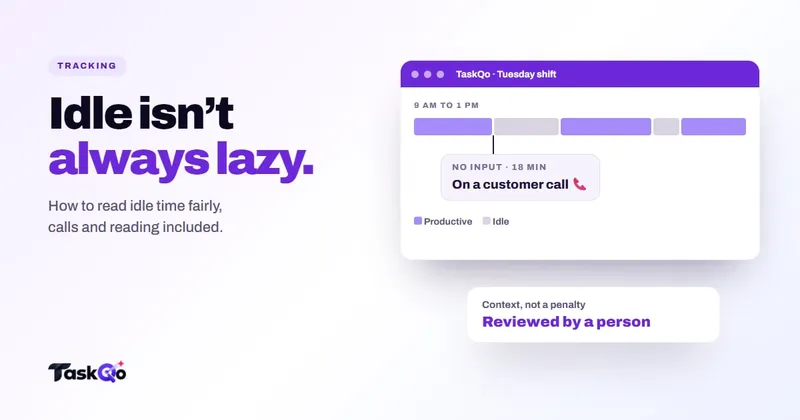
Every tracked minute is also classified as productive, unproductive or idle, with the screenshot and reason attached, so you can see what happened inside the shift, not only when it started. Team members see their own timeline, which makes it easy to spot and fix a wrong record together.
See a sample week of hours and pay in the live demo, or join the waitlist for early access.
Comparing tools: TaskQo vs DeskTime: simple time tracking or AI shift analysis? · TaskQo vs Time Doctor: which is better for BPOs and call centers?.
FAQ
What is a good shift adherence rate?
It depends on your queue, your grace periods and how exceptions are logged. Set a target that fits your demand pattern and compare teams doing similar work rather than chasing a generic number.
What is the difference between schedule adherence and conformance?
Adherence measures whether people worked at the scheduled times. Conformance measures whether they worked the total scheduled time, regardless of when.
Do breaks count against shift adherence?
Scheduled breaks taken on time do not. Breaks that start late or run long usually do, unless they are logged as an approved exception.
How can I improve shift adherence in a call center?
Share clear rules with grace periods, log exceptions like meetings and outages, fix slow login routines, look at patterns over weeks, and ask people about causes before acting.
About this guide: written by the TaskQo team. We make TaskQo, a tool that analyzes work inside scheduled shifts, so we mention it where it fits. The advice here works with any tool. Rules on workplace monitoring differ by country and state, so check local law before you change a policy. Questions or corrections: admin@taskqo.com.