
Key takeaways
- Random samples miss the calls that matter most, like escalations, long holds and lost sales.
- A short scorecard with clear definitions beats a long checklist nobody applies the same way.
- Transcripts let reviewers scan a call in minutes and quote the exact moment to coach.
- QA only pays off when every review ends in a coaching note and a follow-up check.
Why call center quality assurance still runs on samples
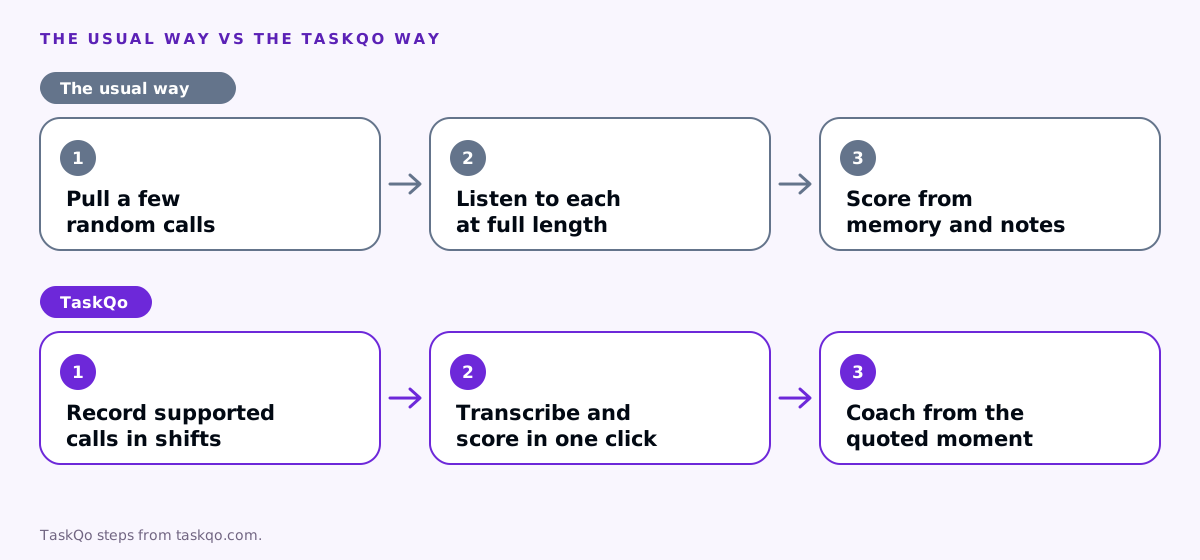
In most contact centers, call center quality assurance means a QA analyst pulls a few calls per agent each month, listens to them in full and fills in a scorecard. The method is familiar, and it made sense when every review meant sitting through a recording at normal speed.
The trouble is the math of attention. An agent may handle dozens of conversations a day, and a reviewer can only listen to so many hours of audio. So the program settles on a handful of calls and treats them as a fair picture of the month.
That picture is often wrong in both directions. A strong agent can be marked down for one awkward call that happened to be picked. A struggling agent can look fine because the sample landed on easy password resets instead of the billing disputes where they lose customers.
None of this is the QA team's fault. It is a capacity problem, and the fix is to change what reviewers spend their time on, not to ask them to listen faster.
What random sampling misses
Random selection is fair in a statistical sense, but it is blind to risk. The calls that most need a second look tend to be a minority, and a small random pull can easily skip all of them.
- Escalations and complaints. The calls where a customer asked for a supervisor or threatened to cancel.
- Long or repeated contacts. A customer calling back about the same issue is a sign the first call did not resolve it.
- Lost sales. In sales teams, the conversations that did not convert hold the clearest coaching moments.
- New agents and new processes. The first weeks after a policy change are when mistakes spread.
A better approach mixes a small random pull, so every agent gets a baseline, with targeted reviews chosen by signals like call length, outcome, customer sentiment or a supervisor's note. The goal is not to catch people. It is to spend limited review time where it can change something.
Build a scorecard agents can trust
A scorecard is only useful if two reviewers would give the same call the same score. Long checklists with vague items like "showed empathy" invite disagreement, and agents notice when their score depends on who listened.
Keep it short and define each item with an example of a pass and a miss:
- Communication. Clear greeting, plain language, no dead air without explanation.
- Issue resolution. Was the problem solved, or was a clear next step agreed?
- Professionalism. Tone, policy compliance and accurate information.
- Customer sentiment. How did the customer sound at the end compared with the start?
Run calibration sessions where the QA team and supervisors score the same calls and compare. Where scores differ, rewrite the definition, not the agent's score. Share the scorecard with agents so they know exactly what good looks like before anyone reviews them.
How transcripts change call review
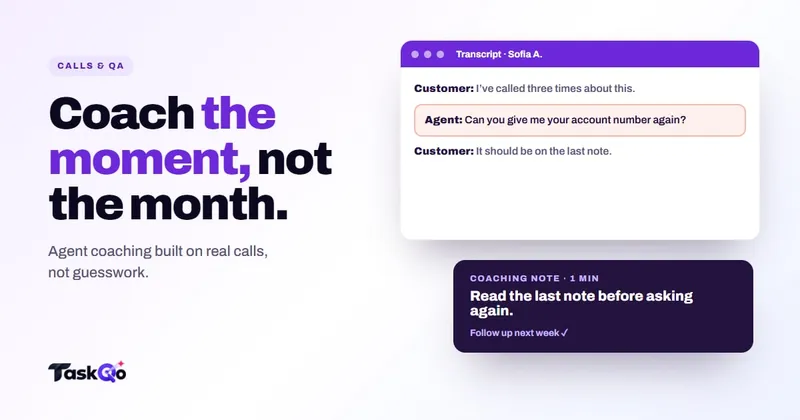
Listening to a full recording is the slowest part of QA. A transcript lets a reviewer skim the whole conversation, jump to the part where the tone shifted and quote the exact words in a coaching session.
Speaker labels matter here. A transcript that shows who said what makes it easy to spot an agent talking over a customer, offering a discount before hearing the objection or skipping a required disclosure.
Transcripts also help multilingual teams. A supervisor who does not speak the language of a call can still review it through a translated transcript, instead of leaving those agents out of QA entirely.
Treat transcripts as a reading aid, not a verdict. Audio still matters for tone, and an automated score is a starting point a person should confirm before it goes on anyone's record.
Choose which calls to review first
Once reviewers can see more calls, the question changes from "which calls can we afford to hear" to "which calls should we hear first". A short, shared priority list keeps reviews consistent across supervisors.
- Calls with a poor outcome. Cancellations, refunds, complaints and unresolved issues.
- Calls with a shift in tone. Conversations where the customer started calm and ended frustrated, or the other way round.
- Calls tied to an open coaching note. The best way to check whether coaching worked.
- Calls from new starters. Early feedback prevents habits from setting in.
- A small random baseline. So every agent is reviewed, not only the ones with difficult calls.
Write the list down and share it with the team. Agents should know why a call was picked, and a mix of targeted and random reviews shows that QA is not only about finding problems. Revisit the list each quarter as products, policies and client expectations change.
Keep an eye on balance across the team too. If one agent's calls are reviewed far more often than their colleagues', ask whether that reflects real need or simply who is easiest to find.
Close the coaching loop
A QA score on its own changes very little. What changes behavior is a short conversation about a specific moment, followed by a check that the new habit stuck.
A simple loop works for most teams:
- Pick one moment. Choose a single behavior from the call, with the quote or timestamp, rather than a list of ten faults.
- Agree on a change. Ask the agent how they would handle it next time, and write it down as a coaching note.
- Check later calls. Review a few of their next relevant calls to see whether the change shows up.
- Close it out. Mark the note as done when it does, or try a different approach when it does not.
Keep praise in the loop too. Pointing to a call that went well shows the whole team what the scorecard means in practice. For more on running these sessions, see our guide to call center agent coaching.
How TaskQo handles call quality assurance
TaskQo is built so reviewers can look at any recorded call, not only a random sample. When call review is enabled, it detects and records both sides of supported calls and meetings during configured shifts. Nothing is captured outside those shifts.
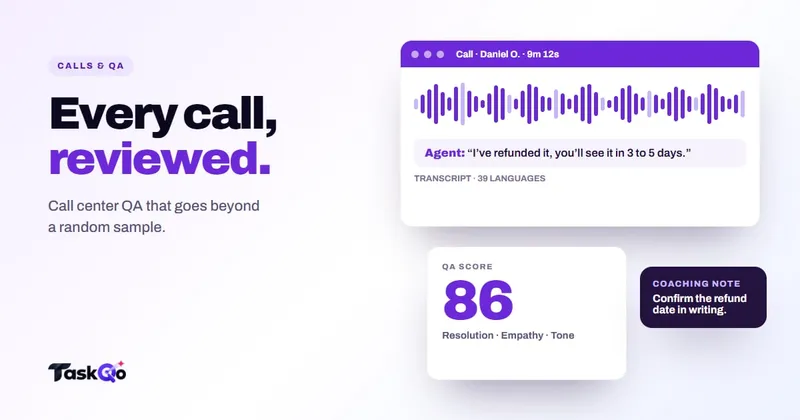
Open any recording and, with one click, TaskQo produces a speaker-labelled transcript in 39 languages, a QA score for communication, issue resolution and professionalism, the customer's reaction, and coaching notes a manager can act on. A note might point out that a discount was offered before the customer's price concern was heard, with a suggestion for what to ask instead.
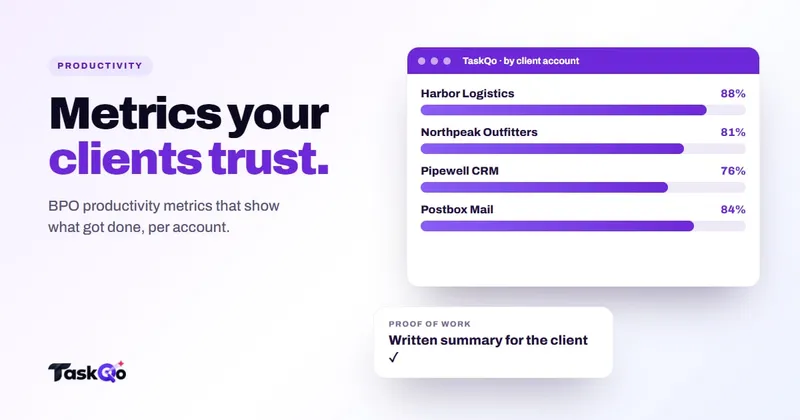
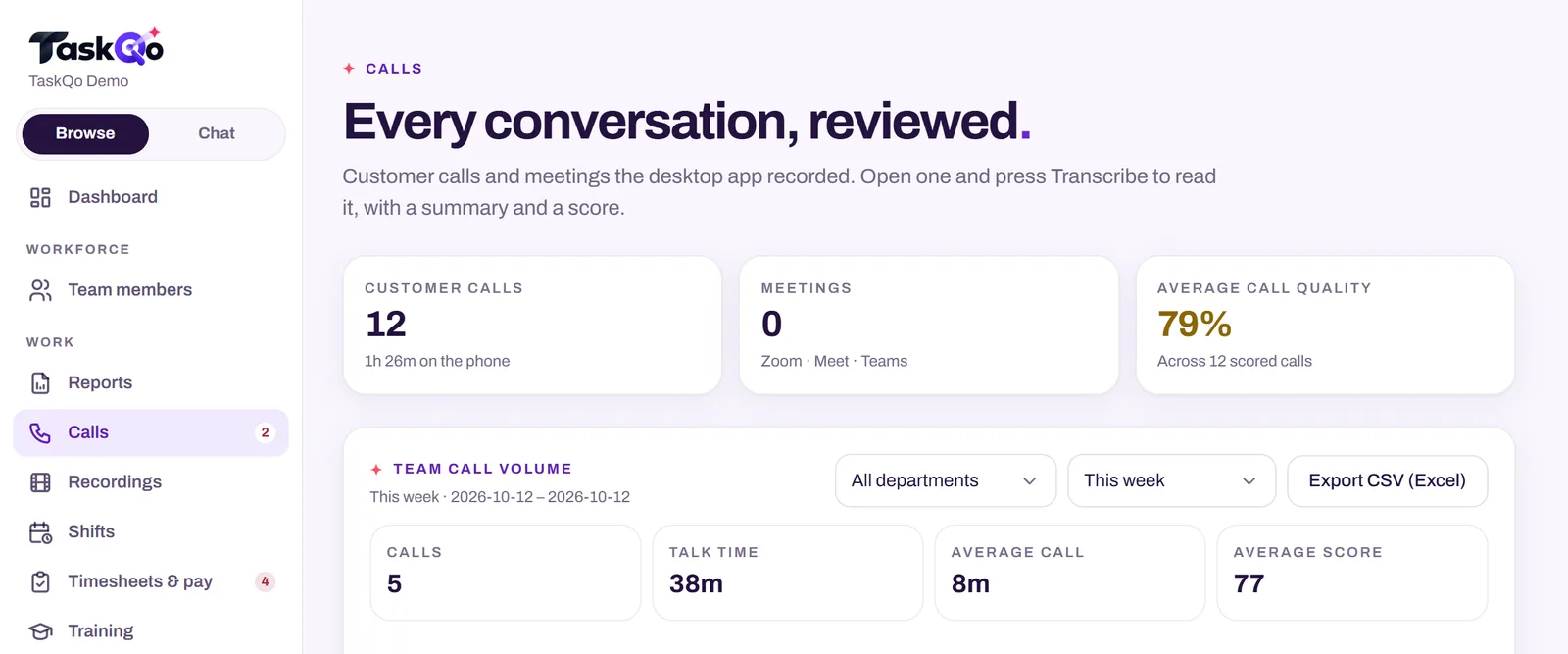
Reports show call quality by person, department and client account, so you can see where coaching is needed. Managers can also ask the TaskQo assistant questions like "Which calls need coaching today?" and get answers drawn from the team's own data. Team members see their own records through self-view, so QA is not something that happens behind their backs.
You can explore recorded calls and QA scores in the live demo with sample data, or join the waitlist for early access.
Keep QA fair for the agents being reviewed
Call review works best when agents see it as support, not surveillance. Tell the team which calls are recorded, why, and who can listen. Make sure they can read their own scores and the notes behind them.
Give agents a way to dispute a score. A customer who was angry before the call started, a system outage or a policy the agent was not trained on are all fair reasons to revisit a result. Recording laws and consent rules differ by country and state, so check local requirements or ask counsel before you start recording calls.
Finally, never let a score alone decide pay or discipline. Use it to start a conversation, look at the full call, and let a person make the decision.
Comparing tools: TaskQo vs Time Doctor: which is better for BPOs and call centers? · TaskQo vs Kickidler (KeepActive): an honest comparison.
FAQ
What is call center quality assurance?
It is the process of reviewing customer calls against a set of standards, scoring them and using the results to coach agents. Most programs cover communication, issue resolution, professionalism and compliance.
How many calls should be reviewed per agent?
There is no single right number. A small random baseline for every agent plus targeted reviews of escalations, repeat contacts and lost sales gives a more useful picture than a larger random sample alone.
What should a call center QA scorecard include?
Keep it to a few clearly defined areas, such as communication, issue resolution, professionalism and customer sentiment, each with an example of a pass and a miss. Calibrate it regularly so reviewers score the same way.
Can AI replace QA analysts?
AI can transcribe and pre-score calls so analysts spend less time listening and more time coaching. A person should still confirm scores and make any decision that affects an agent.
About this guide: written by the TaskQo team. We make TaskQo, a tool that analyzes work inside scheduled shifts, so we mention it where it fits. The advice here works with any tool. Rules on workplace monitoring differ by country and state, so check local law before you change a policy. Questions or corrections: admin@taskqo.com.